
Indigenous-Led Conservation and Kamëntsá Language Revitalization: OIOC's 2026 Community Report

Dear friends,
In Colombia's Sibundoy Valley, OIOC has been bringing together grassroots efforts, community education, conservation, and partnerships rooted in trust. Guided by our director, Taita Juan Bautista Ágreda, who serves as Kamëntsá gobernador, we are working with teachers, elders, families, artisans, and allies to strengthen life in Kamëntsá territory.
We want to thank the organizations and individuals who have trusted us and made this work possible. Your support helps turn reciprocity into action: keeping the Kamëntsá language alive, caring for land and native plants, sharing knowledge across generations, and responding to the needs families name for themselves.
We also honor the Indigenous peoples who have cared for the Putumayo River and the wider Andean-Amazon region over generations. Their languages, plant medicines, and ways of living are part of a living weave of knowledge that continues to grow within communities and offer healing and guidance beyond them. Our ancestral plant medicines remind us that healing begins in relationship—with one another, with the territory, and with the lives that sustain us.
This work carries a hope for Sumak Kawsay, an Andean vision of living well in relationship with nature and community. With gratitude for the guidance of our ancestors and for your help and prayers, we invite you to read this report: to see what we have accomplished together, what is still growing, and how you can help us welcome a new time of care and renewal for Batsanamama—Mother Earth, whom we all share.
91 Students, One Living Language: Our Kamëntsá Language School
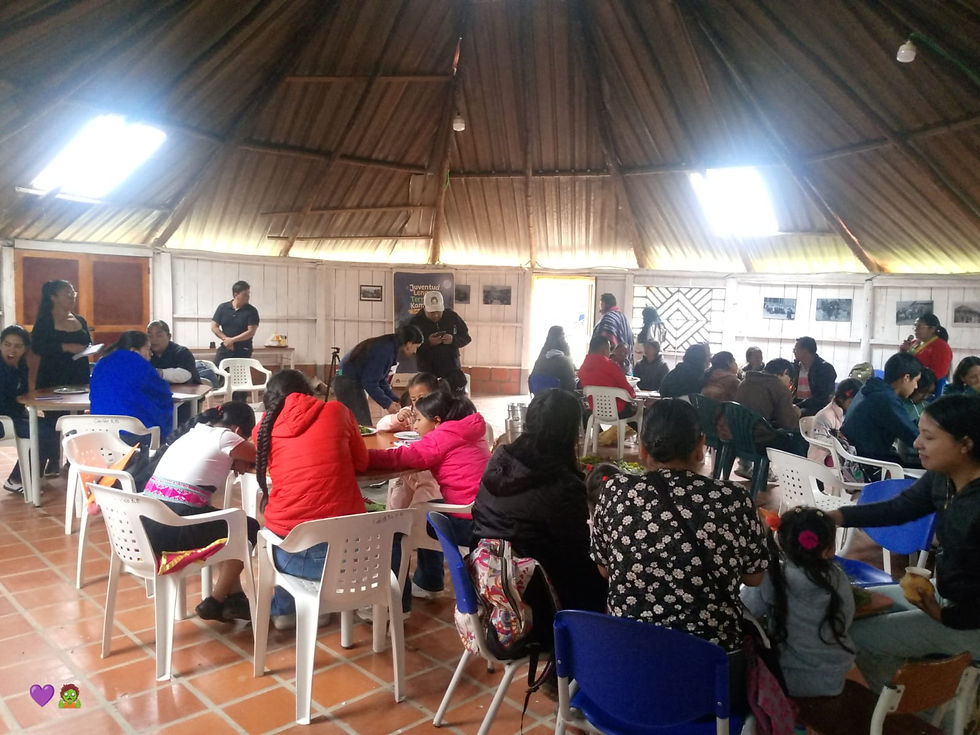
The Mosh Huasginch Kamëntsá Language School is reaching 91 students. With Kamëntsá teachers, children, young people, and adults are learning to speak and carry the language into daily life. Every class is part of a larger effort to make sure future generations can hear, use, and feel at home in their language. Our next task is to sustain the teachers and keep these spaces open long enough for learning to deepen.
73 Students, Living Traditions: Our Kamëntsá Weaving School

Our Ancestral Weaving School now includes 73 students, including young people learning an art many in their generation have not had the chance to practice. Kamëntsá weavers share ancestral techniques alongside the meaning of designs, colors, and symbols, helping restore knowledge that has been fading from daily life. Students strengthen their identity and their relationships with elders while gaining a practical skill that, with fair opportunities to sell their work, can also help support them financially. We want to continue supporting teachers, materials, practice, and pathways for students to develop their craft.
Listening Across Kamëntsá Territory: Shaping a Ten-Year Language Revitalization Strategy.

The community-led Kamëntsá language autodiagnóstico is underway across seven veredas. Fourteen fieldworkers aim to reach 1,978 families to learn where Kamëntsá is spoken, what prevents families from passing it on, and what support they want. The findings will help shape a ten-year language revitalization strategy grounded in what families actually say they need. This is an ongoing process; the household goal and long-term strategy are ahead of us.
Amazon conservation in Colombia: a greenhouse, native trees and medicinal plants for the community

Our earlier conservation efforts have already planted approximately 1,700 native seedlings. We are now planning a new greenhouse for native trees and medicinal plants. It will be a place to raise seedlings and share them with local families for restoration on their lands. Caring for plants also means caring for the water, soil, forests, and living knowledge connected to them. In the next phase, we hope to expand propagation and get more trees and plants into the community's hands.
Indigenous-led plant medicine education: the ILP program

The first cohort of our Indigenous-Led Plant Medicine Science Program (ILP), now underway, brings together 12 participants from around the world. Indigenous knowledge holders and academic collaborators are guiding a six-month learning journey on plant medicines, community authority, ethics, and relationships with territory. The program asks participants to learn with humility and consider what their education gives back.
The ILP's reciprocity effort has supported two hectares of land for ten Kamëntsá families and two months of the language school. This connects international learning with tangible support for the people and places that hold this knowledge. As the cohort continues, we are working to make reciprocity a sustained practice rather than a one-time gesture.
Indigenous land stewardship: seven hectares for the community

Santiago Suárez has contributed US$30,000 to our land-back work. Together with the wider effort, the program's total is seven hectares for the community. Land makes space for families, native plants, cultural practice, and future generations. We hope to keep extending community care and stewardship of this territory.
Community housing: seven homes reconstructed for families
Our housing program has reconstructed seven homes, helping families live in safer, more dignified conditions. More families still need support. We are preparing the next phase of repairs and reconstruction so this effort can reach additional homes.
Support Indigenous-led education, conservation, and housing
These projects belong to one another. A family speaking Kamëntsá at home, a student weaving with an elder, a seedling growing on community land, and a repaired house all contribute to a future shaped by the community itself.
Your support can help us continue the Kamëntsá language and weaving schools, complete the household listening process, raise and distribute native plants, repair more homes, and expand community stewardship of land. If you are looking to support Indigenous-led conservation and cultural revitalization in Colombia, consider a donation, a sustained partnership, or an introduction to someone who shares this vision.
To support the next phase or discuss a partnership, please write to info@oioc.co.
With gratitude,
OIOC team
Sibundoy Valley, Putumayo, Colombia


Comments