
Indigenous-led Science as an accountable and reciprocal method of caring for people, territory and culture.
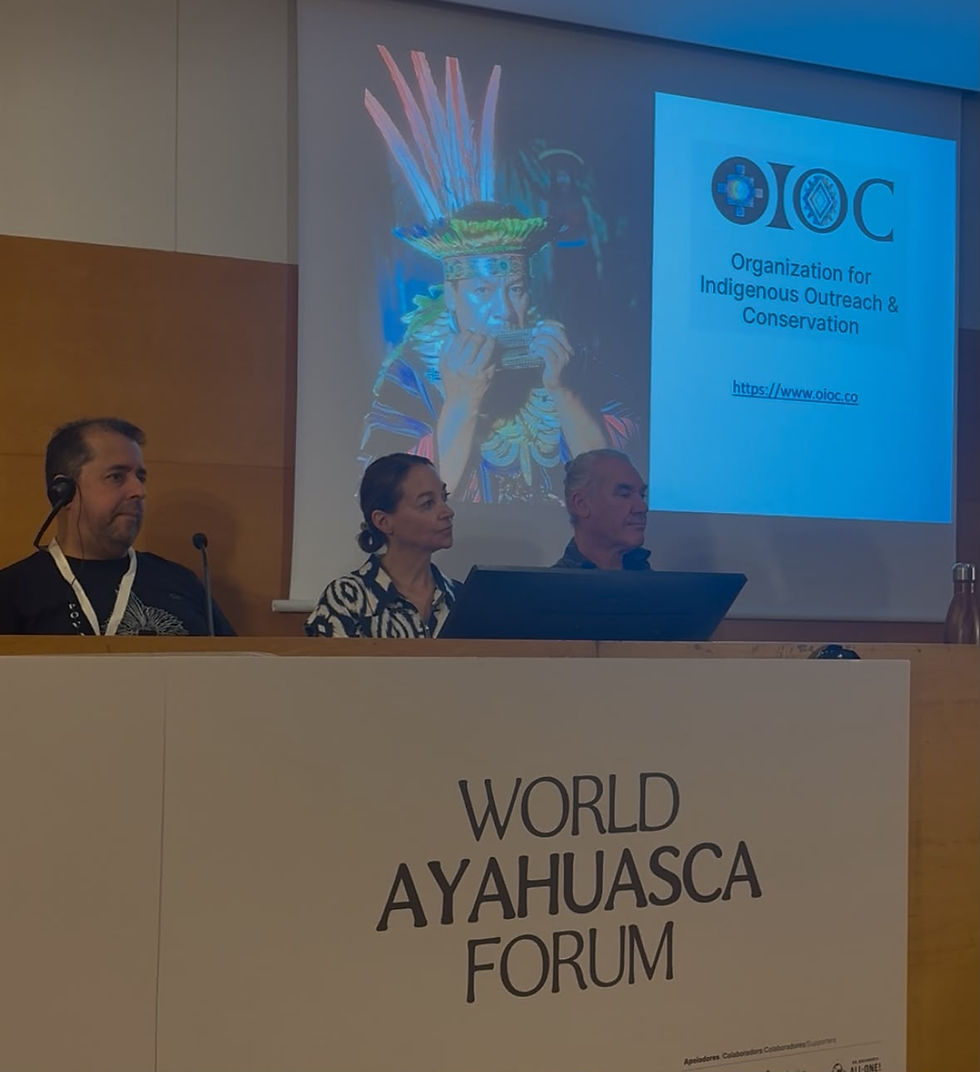
During the World Ayawaska Conference held in Girona in 2026, OIOC had the privilege to share stage presence with Drug Science and Arno Adelaars to raise awareness about the importance of Indigenous-led science.
My name is Melany Zarate, I am a biosocial medical anthropologist, currently I hold the operations of the Indigenous-led program (ILP). I had the privilege of being a bridge between Colombia, OIOC and the currently active ILP. My aim is to share with you my understanding of what happened in the conference, and what can be taken forward as a result.
The Indigenous-led science program developed alongside the Kamëntšá and Kofan knowledge holders in Colombia is hoping to build an intercultural bridge with care.
The program reinvindicates ancestral knowledge held in community, and teaches; ecology, reciprocity and consciousness studies, offering a new paradigm of intercultural sciences.
We celebrate the beginning of the first cohort of students from 10 countries around the world. Together we are choosing to believe that accountable, ethical and excellent education is possible alongside the communities who have cared for this knowledge for millennia.
Today, thanks to the program, an important contribution has been made: A purchase of 2 hectares of land that currently house 10 families and a 2 month program for the local language school, currently revitalizing an indigenous endangered language.
Cosmic diplomacy as the art of relational, contextual and reparative care.
The world stage congregated crucial topics around regulation, ethics, law, environmental rights, indigenous representation and globalization. Indigenous leaders called for respect, they asked at the main stage for ayahuaska not to be called a psychedelic, but a sacred medicine. This invitation in my eyes is the continuation of the heart full movement to expand our definitions of health beyond the individuals to include the wellbeing of our ecosystems, and all the beings that inhabit within them.

The world is living through a decisive moment. In the month of August, a report from the UN said we are no longer going to keep global temperatures below the 1.5 degrees limit. This means that we collectively have missed the chance of preventing the worst of global warming harms. Scientists know that living on this warmer planet will need adaptation and a strong movement of our governments, laws, civil society, clinics and therapists to respond to the need to respect our natural world.
But, how is this connected to ayahuasca?
People around the world are attracted to the use of plant medicine to find healing and repair in their lives. Many pay thousands to encounter these medicines and the promise of healing. The need for healing comes from a collective experience of disharmony brought by oppression, war, injustice and hatred. More often than not, when seeking healing from these collective processes of suffering, individuals are compartmentalized to confront their circumstances without challenging the ongoing trends of self-actualization which do not include practices of reciprocity with people, and the ecosystems we depends on. Overall, how healing is defined and experienced differs depending on each person’s perspective, culture and location.
Elders in the World Ayahuasca Forum emphasized the importance of the cultures, places and peoples who live and understand how to co-exist in close harmonious relationship with the earth as a way of living.
Elders argued that isolating individual health from collective health, leads to health institutions and practitioners often missing the ongoing injustices happening worldwide. Shifting the disconnection between individuals, their health and the natural world to more coherent intercultural bridges of truth is the work we desperately need. For that reason, I would like to highlight a drastic contradiction. On one side, those who live closest to the ecosystems, people and culture that have gifted plant medicines are shouldering, often isolated from international scrutiny, the impact of the ongoing injustice of religious indoctrination, extractivism by corporations and governments that discredit their rights. On the other side, the plants alongside the knowledge of their therapeutic potential present in these incredibly biodiverse ecosystems are sitting under the spotlight of the international demand for healing and repair.
But often, the international attention and care is not extended to the peoples who have cared for these plants and cosmovisions for millennia. The conference called, A New Time of Alliance proposed for a collective movement in support of the ways of life that honors these crucial ecosystems.

The first step in that direction in my opinion is to recognize the importance of culture, land and people in the humanities and scientific field worldwide. A fruitful outcome of the conference in taking that first step, was the collective effort of the Indigenous representatives and lecturers invited to share their work, to attempt to explain the biocultural dimensions of plant medicines. Multiple simultaneous lectures exposed terminology and praxis, which brought the audience closer to a more holistic understanding of health, through the inclusion of culture, territory and the social realities of the people. The biocultural dimension, a contested field in academia by activists for decades, argues that by recognizing our interconnection with our natural ecosystems, and all biodiversity as key components of health and wellbeing, there would be grater support for a stronger movement behind not disregarding disharmonious relationships with plant medicines and the ecosystems which they originate from. I believe that this process to resignify our relationship with the natural world, would bring to the spotlight the need to respect the peoples who ensure the care and transmission of the biocultural knowledge the world depends on onto future generations.
Ultimately, by centering Indigenous cosmovision within a framework of health, the biocultural dimension aims to de-center the singular focus on humans and refocus the frame at a more holistic picture to the interdependent relationships between people, culture and land--sources of the safety, health and wellbeing we need.
As our planet is burning, we are ever more ever reminded of the close connection we have with the natural world. The conference concluded that, ayahuasca, for that same reason needs to be understood within a place boundary, culture and social reality of the people.
But this then brings the question which people do we centre in the conversation?
The globalized culture of our time has taught us to center the individual and human perspective in all conversations. For a long time, indigenous peoples were not even regarded to be human under the eyes of the colonizing world. Therefore, there is a trend to center the experiences of those closest to European standing.
Because the use of Ayahuasca has expanded beyond the territories where it originates, in my opinion, the people who receive the global attention will be determined by our capacity to interiorize the main request of the conference–to expand our definition of health. A definition that includes the waters, the soil and the cultures which can provide much of the answers about how to live beyond systems of infinite capital gain. Given that, disharmonious collective systems have brought much of the destruction of the natural world alongside with the cultures that care for them.
Ethics as care, reciprocity and accountability in plant medicine practice
The elders gave an important example about their concerns of the impact of taking plant medicines outside of their sacred context. The use of the tobacco and coca leaf, very revered plants in the Andean-Amazonian cosmovision, today are an example of how the decontextualized use of plants can ultimately cause more harm than good when it is not sustained within firm ethical principles. Therefore, building the intercultural bridges with the millenary cultures that can teach humanity how to embrace a way of life which is embedded in principles of peace and love for the earth is essential.
As the health systems worldwide experience the crumbling of the isolated individualized perspectives of health, more focus will be placed on alternative forms of healing. But it is our duty to build trust, containers and ethical praxis to ensure the death of the worldview of division opens the door to a new more holistic way of interconnectedness between people and its living world.
I firmly believe that OIOC is building a container that can lead as an example of how to bring different worldviews together in peace. To learn and discover what health and healing can look like, when we have culture, territory and people at the centre of the conversation. Being part of such containers is a really profound privilege, I hope many people can experience it in their lifetime. Not a promised future, but a present practice filled with meaning and gifts to the needs of humanity and future generations to come.


Comments